Original: $20.93
-65%$20.93
$7.33The Story
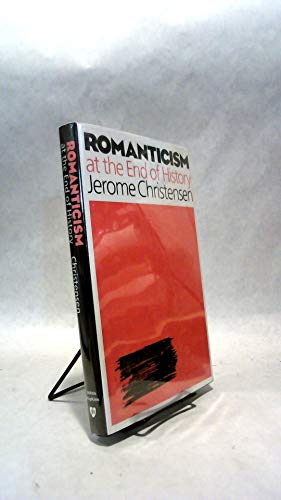
The Romantics lived through a turn of the century that seemed to mark an end to history as it had long been understood. They faced accelerated change, including unprecedented state power, mass armies capable of mass destruction, a polyglot imperial system and a market economy driven by speculation. In this study, Jerome Christensen chooses as his points of departure the dates 1798, 1802 and 1815 - times of war, truce and peace - to reconsider how English Romantic writers defined their relationship to radical social and political changes that seemed answerable to no author and directed to no clear goal. Opposing the prevailing attitude that Romanticism is an extended exercise in bad faith to be condemned for its denial of the facts of social injustice, Christensen shows that the ethic capably imagined by the Romantics is the tool, not just the object, of critique. In a revisionary account of the way first-generation Romantics responded to the crisis of revolution and war, he identifies the emergence of an anthropological imagination that conceived of poetry as the notation of fugitive differences that escaped the impasse of England versus France, friend versus foe.
Christensen produces provocative and searching readings of the poetry of Wordsworth; the poems, criticism, and journalism of Coleridge; the "Confessions" of De Quincey; and Sir Walter Scott's "Waverley". He concludes that, in practice, Romanticism matters because it promotes and performs "an ethics of imaginative, collaborative work." In the book's final chapter, Christensen applies this idea of Romantic ethics to modern-day academia, prompting a reconsideration of how universities ought to approach the study of the humanities in a time of rapid technological innovation and dislocating social change.
Description
The Romantics lived through a turn of the century that seemed to mark an end to history as it had long been understood. They faced accelerated change, including unprecedented state power, mass armies capable of mass destruction, a polyglot imperial system and a market economy driven by speculation. In this study, Jerome Christensen chooses as his points of departure the dates 1798, 1802 and 1815 - times of war, truce and peace - to reconsider how English Romantic writers defined their relationship to radical social and political changes that seemed answerable to no author and directed to no clear goal. Opposing the prevailing attitude that Romanticism is an extended exercise in bad faith to be condemned for its denial of the facts of social injustice, Christensen shows that the ethic capably imagined by the Romantics is the tool, not just the object, of critique. In a revisionary account of the way first-generation Romantics responded to the crisis of revolution and war, he identifies the emergence of an anthropological imagination that conceived of poetry as the notation of fugitive differences that escaped the impasse of England versus France, friend versus foe.
Christensen produces provocative and searching readings of the poetry of Wordsworth; the poems, criticism, and journalism of Coleridge; the "Confessions" of De Quincey; and Sir Walter Scott's "Waverley". He concludes that, in practice, Romanticism matters because it promotes and performs "an ethics of imaginative, collaborative work." In the book's final chapter, Christensen applies this idea of Romantic ethics to modern-day academia, prompting a reconsideration of how universities ought to approach the study of the humanities in a time of rapid technological innovation and dislocating social change.