Original: $57.55
-65%$57.55
$20.14The Story
Secondhand Literary & Historical Fiction Bargain Box — 18 Books
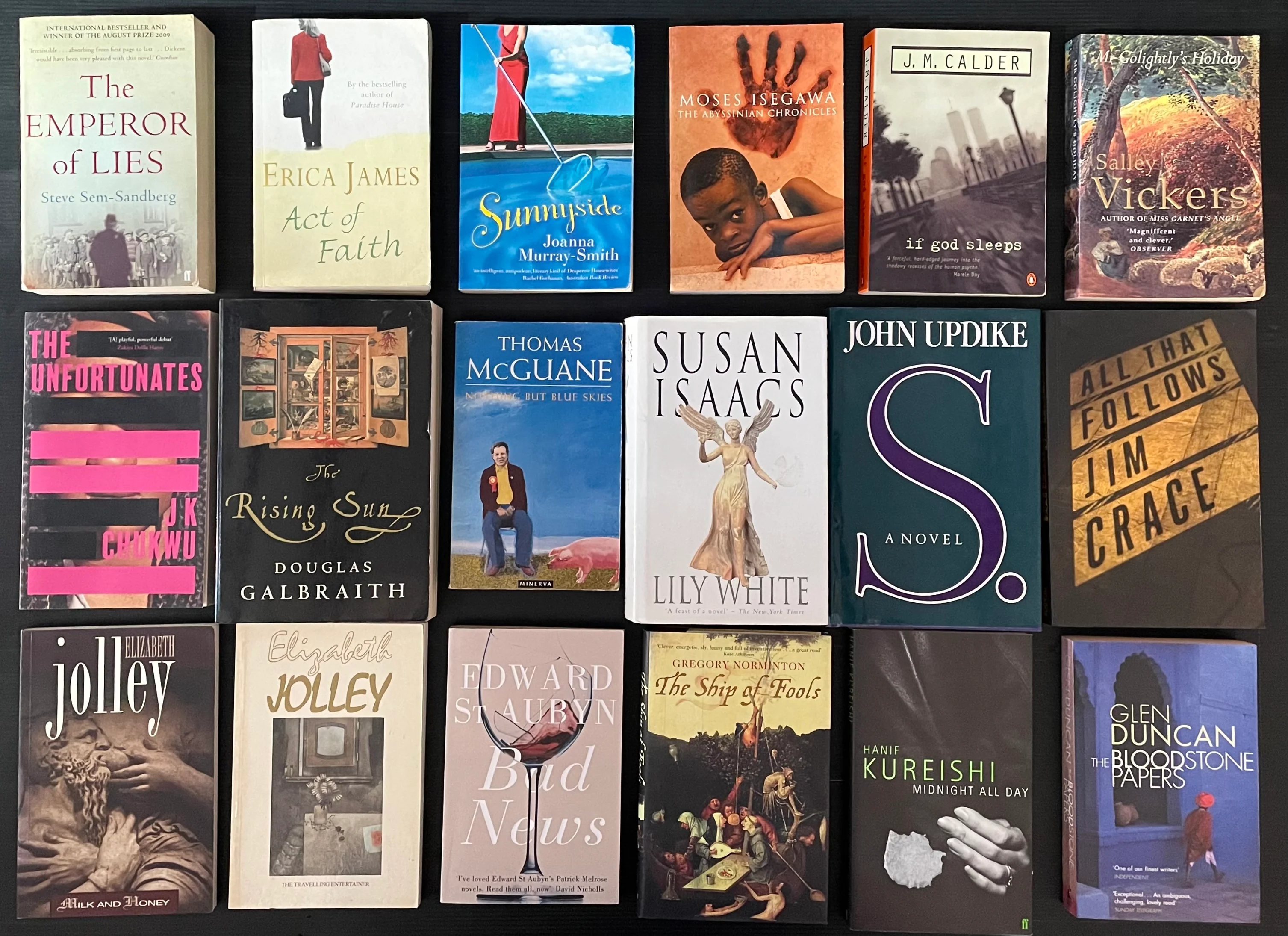
Eighteen novels and story collections for readers who want their fiction to do something more than pass the time. This is a serious collection — an August Prize-winning Holocaust novel, two Elizabeth Jolley rarities, a Patrick Melrose instalment, Moses Isegawa's extraordinary Ugandan epic, Jim Crace at his most urgent, John Updike reimagining Hawthorne, and Glen Duncan doing what Glen Duncan does best: making you feel the ground shift under your feet. Salley Vickers sends God on holiday in Devon. Thomas McGuane takes apart a Montana life with surgical precision. There's not a filler among them.
1. The Emperor of Lies — Steve Sem-Sandberg Winner of the August Prize 2009 and one of the essential novels about the Holocaust. Sem-Sandberg reconstructs the world of the Łódź Ghetto and the impossible figure of Mordechai Rumkowski — the Jewish Elder who collaborated with the Nazis to keep his people alive, or to save himself, depending on who you ask. The Guardian called it "irresistible... absorbing from first page to last." Dickens would have been proud of this novel. Devastating and indispensable.
2. Act of Faith — Erica James From the bestselling author of Paradise House — a contemporary novel about the choices people make when their lives stop making sense. James writes with warmth and emotional precision about the things that pull families apart and occasionally hold them together.
3. Sunnyside — Joanna Murray-Smith Murray-Smith is one of Australia's finest playwrights, and it shows — this novel has a playwright's ear for what people say when they mean something else entirely. Set at a luxury retreat where nothing is quite as serene as it appears, it's sharp, witty, and harder to put down than it looks.
4. The Abyssinian Chronicles — Moses Isegawa A Ugandan boy grows up in the shadow of Idi Amin's dictatorship and finds his way to Europe, carrying the weight of everything he has witnessed. Isegawa writes with the force and scope of the great nineteenth-century novelists — this is African literature of the highest order, and it deserves a far wider readership than it has.
5. If God Sleeps — J.M. Calder "A ferocile, hard-edged journey into the contrary recesses of the human psyche." Literary fiction with genuine darkness at its centre — the kind of novel that refuses the comforts most books reach for and is better for it.
6. Mr Golightly's Holiday — Salley Vickers God — or someone very like him — takes a holiday in a small Devon village and attempts to update his greatest work for the modern age. Salley Vickers (Miss Garnet's Angel) writes with a gentleness that conceals real philosophical depth. The Observer called it "magnificent and clever," and the novel earns both adjectives.
7. The Unfortunates "A playful, powerful debut" — a novel that announces a significant new voice with real confidence. The cover design alone signals a writer who thinks carefully about form as well as content.
8. The Rising Sun — Douglas Galbraith A masterful historical novel about the Darien Scheme — Scotland's catastrophic attempt to establish a colony in Panama in the 1690s, which bankrupted the nation and made the Act of Union virtually inevitable. Galbraith reconstructs this forgotten disaster from the inside, and the result is both gripping history and a deeply human story about hubris and its costs.
9. Nothing But Blue Skies — Thomas McGuane A Montana rancher watches his life fall apart — marriage, business, self-respect — and can't quite stop himself from helping it along. McGuane is one of America's finest and most underread literary novelists, and this may be his most accessible book: funny, painful, and completely true.
10. Lily White — Susan Isaacs A Long Island defense attorney takes a case that cuts uncomfortably close to her own carefully constructed life. Isaacs writes legal fiction with more psychological intelligence than the genre usually demands — the New York Times called this "a feast of a novel."
11. S. — John Updike Updike's feminist reimagining of The Scarlet Letter — a woman leaves her husband and her comfortable Massachusetts life to join an ashram in Arizona, and tells the story entirely through her letters home. Audacious, funny, and more subversive than Updike is usually given credit for being.
12. All That Follows — Jim Crace A retired jazz musician sees a former acquaintance on television, holding a family hostage — and must decide whether to act on what he knows. Crace is one of British fiction's most singular voices, and this urgent, morally complex novel asks what it costs to stay silent when you could speak.
13. Milk and Honey — Elizabeth Jolley One of two Jolley titles in this box, and a genuine rarity. Jolley is one of the most important writers Australia has produced — strange, dark, funny, and entirely her own. If you haven't read her, this is an extraordinary place to start.
14. The Travelling Entertainer — Elizabeth Jolley The second Jolley — short fiction that showcases the full range of her unsettling, compassionate, deeply original imagination. Two Jolley titles in one box is the kind of luck that shouldn't be passed up.
15. Bad News — Edward St Aubyn The second Patrick Melrose novel, and many readers' favourite — Patrick flies to New York to collect his monstrous father's ashes while in the grip of a heroin addiction that St Aubyn renders with clinical, darkly comic precision. David Nicholls said "I've loved Edward St Aubyn's Patrick Melrose novels. Read them all, now." He's right. Start here.
16. The Ship of Fools — Gregory Norminton Inspired by Bosch's painting and Brant's poem — a novel of medieval Europe that is simultaneously an allegory for now. The New York Times called it "clever, energetic, sly, funny and full of surprises." A genuinely original work of historical literary fiction.
17. Midnight All Day — Hanif Kureishi Short stories about desire, disappointment, and the gap between the lives Londoners live and the lives they thought they'd have. Kureishi is at his most concentrated in this form — each story lands like a quietly thrown punch.
18. The Bloodstone Papers — Glen Duncan A half-Indian, half-English writer excavates his family's history across two continents and discovers that the stories we tell about ourselves are never quite the ones we intended. Glen Duncan is "one of our finest writers," and this — ambitious, challenging, morally alive — is the proof.
Description
Secondhand Literary & Historical Fiction Bargain Box — 18 Books
Eighteen novels and story collections for readers who want their fiction to do something more than pass the time. This is a serious collection — an August Prize-winning Holocaust novel, two Elizabeth Jolley rarities, a Patrick Melrose instalment, Moses Isegawa's extraordinary Ugandan epic, Jim Crace at his most urgent, John Updike reimagining Hawthorne, and Glen Duncan doing what Glen Duncan does best: making you feel the ground shift under your feet. Salley Vickers sends God on holiday in Devon. Thomas McGuane takes apart a Montana life with surgical precision. There's not a filler among them.
1. The Emperor of Lies — Steve Sem-Sandberg Winner of the August Prize 2009 and one of the essential novels about the Holocaust. Sem-Sandberg reconstructs the world of the Łódź Ghetto and the impossible figure of Mordechai Rumkowski — the Jewish Elder who collaborated with the Nazis to keep his people alive, or to save himself, depending on who you ask. The Guardian called it "irresistible... absorbing from first page to last." Dickens would have been proud of this novel. Devastating and indispensable.
2. Act of Faith — Erica James From the bestselling author of Paradise House — a contemporary novel about the choices people make when their lives stop making sense. James writes with warmth and emotional precision about the things that pull families apart and occasionally hold them together.
3. Sunnyside — Joanna Murray-Smith Murray-Smith is one of Australia's finest playwrights, and it shows — this novel has a playwright's ear for what people say when they mean something else entirely. Set at a luxury retreat where nothing is quite as serene as it appears, it's sharp, witty, and harder to put down than it looks.
4. The Abyssinian Chronicles — Moses Isegawa A Ugandan boy grows up in the shadow of Idi Amin's dictatorship and finds his way to Europe, carrying the weight of everything he has witnessed. Isegawa writes with the force and scope of the great nineteenth-century novelists — this is African literature of the highest order, and it deserves a far wider readership than it has.
5. If God Sleeps — J.M. Calder "A ferocile, hard-edged journey into the contrary recesses of the human psyche." Literary fiction with genuine darkness at its centre — the kind of novel that refuses the comforts most books reach for and is better for it.
6. Mr Golightly's Holiday — Salley Vickers God — or someone very like him — takes a holiday in a small Devon village and attempts to update his greatest work for the modern age. Salley Vickers (Miss Garnet's Angel) writes with a gentleness that conceals real philosophical depth. The Observer called it "magnificent and clever," and the novel earns both adjectives.
7. The Unfortunates "A playful, powerful debut" — a novel that announces a significant new voice with real confidence. The cover design alone signals a writer who thinks carefully about form as well as content.
8. The Rising Sun — Douglas Galbraith A masterful historical novel about the Darien Scheme — Scotland's catastrophic attempt to establish a colony in Panama in the 1690s, which bankrupted the nation and made the Act of Union virtually inevitable. Galbraith reconstructs this forgotten disaster from the inside, and the result is both gripping history and a deeply human story about hubris and its costs.
9. Nothing But Blue Skies — Thomas McGuane A Montana rancher watches his life fall apart — marriage, business, self-respect — and can't quite stop himself from helping it along. McGuane is one of America's finest and most underread literary novelists, and this may be his most accessible book: funny, painful, and completely true.
10. Lily White — Susan Isaacs A Long Island defense attorney takes a case that cuts uncomfortably close to her own carefully constructed life. Isaacs writes legal fiction with more psychological intelligence than the genre usually demands — the New York Times called this "a feast of a novel."
11. S. — John Updike Updike's feminist reimagining of The Scarlet Letter — a woman leaves her husband and her comfortable Massachusetts life to join an ashram in Arizona, and tells the story entirely through her letters home. Audacious, funny, and more subversive than Updike is usually given credit for being.
12. All That Follows — Jim Crace A retired jazz musician sees a former acquaintance on television, holding a family hostage — and must decide whether to act on what he knows. Crace is one of British fiction's most singular voices, and this urgent, morally complex novel asks what it costs to stay silent when you could speak.
13. Milk and Honey — Elizabeth Jolley One of two Jolley titles in this box, and a genuine rarity. Jolley is one of the most important writers Australia has produced — strange, dark, funny, and entirely her own. If you haven't read her, this is an extraordinary place to start.
14. The Travelling Entertainer — Elizabeth Jolley The second Jolley — short fiction that showcases the full range of her unsettling, compassionate, deeply original imagination. Two Jolley titles in one box is the kind of luck that shouldn't be passed up.
15. Bad News — Edward St Aubyn The second Patrick Melrose novel, and many readers' favourite — Patrick flies to New York to collect his monstrous father's ashes while in the grip of a heroin addiction that St Aubyn renders with clinical, darkly comic precision. David Nicholls said "I've loved Edward St Aubyn's Patrick Melrose novels. Read them all, now." He's right. Start here.
16. The Ship of Fools — Gregory Norminton Inspired by Bosch's painting and Brant's poem — a novel of medieval Europe that is simultaneously an allegory for now. The New York Times called it "clever, energetic, sly, funny and full of surprises." A genuinely original work of historical literary fiction.
17. Midnight All Day — Hanif Kureishi Short stories about desire, disappointment, and the gap between the lives Londoners live and the lives they thought they'd have. Kureishi is at his most concentrated in this form — each story lands like a quietly thrown punch.
18. The Bloodstone Papers — Glen Duncan A half-Indian, half-English writer excavates his family's history across two continents and discovers that the stories we tell about ourselves are never quite the ones we intended. Glen Duncan is "one of our finest writers," and this — ambitious, challenging, morally alive — is the proof.