Original: $57.55
-65%$57.55
$20.14The Story
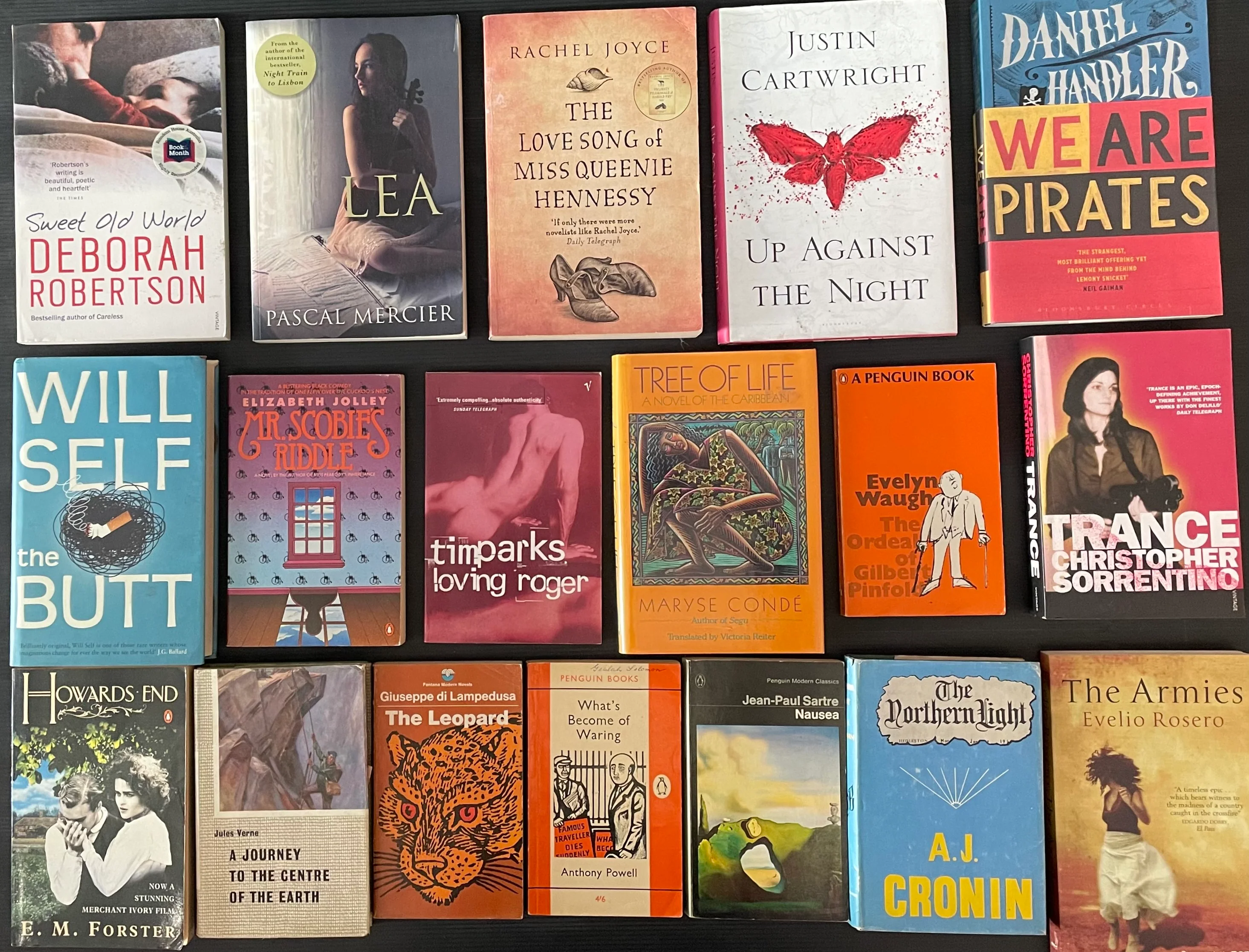
Secondhand Literary & Historical Fiction Bargain Box — 18 Books
This one is the box for readers who mean business. Alongside contemporary literary fiction from Rachel Joyce, Justin Cartwright, Will Self, and the Nobel laureate Maryse Condé, the bottom row alone contains Howards End, The Leopard, Nausea, and Anthony Powell — four novels that belong on any serious reader's shelves. Add Pascal Mercier following up Night Train to Lisbon, Christopher Sorrentino's epoch-defining reimagining of the Patty Hearst kidnapping, and Evelio Rosero's devastating Colombian masterpiece, and you have a collection that would cost a great deal to assemble new.
1. Sweet Old World — Deborah Robertson The author of Careless writes about grief, love, and the surprising directions a life can take when everything falls apart and has to be rebuilt. The Times called Robertson's writing "beautiful, poetic and heartfelt" — this is Australian literary fiction operating at a high level.
2. Lea — Pascal Mercier From the author of Night Train to Lisbon — a novel about a gifted young cellist, a mysterious student, and the way music can become the language for everything we cannot otherwise say. Mercier (the pen name of Swiss philosopher Peter Bieri) writes about the inner life with extraordinary precision and tenderness.
3. The Love Song of Miss Queenie Hennessy — Rachel Joyce The companion to The Unlikely Pilgrimage of Harold Fry, told from the perspective of the woman Harold is walking to reach. You don't need to have read the first novel — but if you have, this one will devastate you in the best possible way. The Daily Telegraph said "if only there were more novelists like Rachel Joyce." Correct.
4. Up Against the Night — Justin Cartwright Cartwright's late novel about South Africa, ageing, and the country of memory — returning to the landscape and preoccupations that have animated his finest work. For a writer who spent a career circling the question of what it means to be South African, this is a summation.
5. We Are Pirates — Daniel Handler Daniel Handler writes for adults under his own name and for children as Lemony Snicket — and this novel has the anarchic dark energy of both. A San Francisco radio producer and his teenage daughter, who decides to become a real pirate. Neil Gaiman called it "the strangest, most brilliant offering yet" from a writer who has made strangeness his signature.
6. The Butt — Will Self A man on holiday accidentally flicks a cigarette butt onto a fellow tourist, causing minor injuries — and the legal consequences spiral into a Kafkaesque nightmare in a fictional postcolonial state. Self uses the absurd premise to eviscerate colonial guilt, legal theatre, and the peculiar cowardice of the comfortable man. J.G. Ballard said Self "will be one of those rare writers who dangerous change for ever the way we see the world."
7. Mr Scobie's Riddle — Elizabeth Jolley A nursing home, its residents, and the staff who condescend to and occasionally prey upon them — rendered by Jolley with dark comedy and fierce compassion that no other Australian writer could have managed. A second copy of a novel that deserves to be in twice as many hands as it currently is.
8. Loving Roger — Tim Parks An early novel from the British writer who has spent decades translating and living in Italy — an intense, claustrophobic study of obsessive love and the stories we tell ourselves about the people who harm us. Parks writes psychological interiority with a precision that is almost uncomfortable.
9. Tree of Life — Maryse Condé A sweeping family saga set across Guadeloupe and the wider Caribbean diaspora — Condé, who was awarded the Nobel Prize in Literature, traces one family through generations of migration, memory, and reinvention. Victoria Reiter's translation preserves the lush, layered texture of Condé's original. An essential work of world literature.
10. The Ordeal of Gilbert Pinfold — Evelyn Waugh A famous novelist goes on a cruise to recuperate and begins hearing voices. Semi-autobiographical, deeply strange, and surprisingly funny — Waugh anatomises his own breakdown with the merciless precision he usually reserved for other people. One of his most personal and underrated works.
11. Trance — Christopher Sorrentino A reimagining of the Patty Hearst kidnapping — one of the defining American stories of the twentieth century — told through multiple perspectives with formal ambition and moral complexity. The Daily Telegraph called it "an epic, epoch-defining achievement." It is exactly that.
12. Howards End — E.M. Forster "Only connect." One of the great English novels — about class, culture, and the collision between the intellectual Schlegel sisters and the commercial Wilcox family in Edwardian England. If you haven't read it, this is your chance. If you have, you know it repays rereading.
13. A Journey to the Centre of the Earth — Jules Verne The classic that invented a genre — a German professor, his nephew, and a descent through an Icelandic volcano into the impossible interior of the world. Verne's imagination created the template for adventure fiction that writers are still borrowing from.
14. The Leopard — Giuseppe di Lampedusa One of the great novels of the twentieth century — full stop. The aging Sicilian prince watching his world dissolve into the new Italy, understanding that everything must change so that everything can stay the same. Stendhal, Tolstoy, and something uniquely Sicilian all at once. If this box contained nothing else, it would be worth buying for this.
15. What's Become of Waring — Anthony Powell A witty, elegant early novel from the author of A Dance to the Music of Time — about the mysterious disappearance of a famous travel writer and the chaos his absence creates among those who traded on his name. Powell's comic intelligence is fully formed even here, and the Penguin edition is a beautiful thing.
16. Nausea — Jean-Paul Sartre The existentialist novel — Roquentin's diary of alienation in a French provincial town, as the world reveals itself to be contingent, meaningless, and viscerally, nauseatingly present. Required reading for anyone who has ever wondered whether philosophy can do what fiction does. It can. This is the proof.
17. The Northern Light — A.J. Cronin Cronin (The Citadel, The Keys of the Kingdom) at his most passionate — a newspaper owner facing the battle between integrity and commercial pressure that is, if anything, more relevant now than when it was written. Cronin understood ordinary decency and its costs better than almost any novelist of his era.
18. The Armies — Evelio Rosero A retired schoolteacher in a Colombian village watches his world consumed by the three-way violence of paramilitaries, guerrillas, and the army. Winner of the Independent Foreign Fiction Prize and described by El País as "a timeless epic." Rosero writes about atrocity with a restraint that makes it unbearable — this is one of the essential Latin American novels of the twenty-first century.
Description
Secondhand Literary & Historical Fiction Bargain Box — 18 Books
This one is the box for readers who mean business. Alongside contemporary literary fiction from Rachel Joyce, Justin Cartwright, Will Self, and the Nobel laureate Maryse Condé, the bottom row alone contains Howards End, The Leopard, Nausea, and Anthony Powell — four novels that belong on any serious reader's shelves. Add Pascal Mercier following up Night Train to Lisbon, Christopher Sorrentino's epoch-defining reimagining of the Patty Hearst kidnapping, and Evelio Rosero's devastating Colombian masterpiece, and you have a collection that would cost a great deal to assemble new.
1. Sweet Old World — Deborah Robertson The author of Careless writes about grief, love, and the surprising directions a life can take when everything falls apart and has to be rebuilt. The Times called Robertson's writing "beautiful, poetic and heartfelt" — this is Australian literary fiction operating at a high level.
2. Lea — Pascal Mercier From the author of Night Train to Lisbon — a novel about a gifted young cellist, a mysterious student, and the way music can become the language for everything we cannot otherwise say. Mercier (the pen name of Swiss philosopher Peter Bieri) writes about the inner life with extraordinary precision and tenderness.
3. The Love Song of Miss Queenie Hennessy — Rachel Joyce The companion to The Unlikely Pilgrimage of Harold Fry, told from the perspective of the woman Harold is walking to reach. You don't need to have read the first novel — but if you have, this one will devastate you in the best possible way. The Daily Telegraph said "if only there were more novelists like Rachel Joyce." Correct.
4. Up Against the Night — Justin Cartwright Cartwright's late novel about South Africa, ageing, and the country of memory — returning to the landscape and preoccupations that have animated his finest work. For a writer who spent a career circling the question of what it means to be South African, this is a summation.
5. We Are Pirates — Daniel Handler Daniel Handler writes for adults under his own name and for children as Lemony Snicket — and this novel has the anarchic dark energy of both. A San Francisco radio producer and his teenage daughter, who decides to become a real pirate. Neil Gaiman called it "the strangest, most brilliant offering yet" from a writer who has made strangeness his signature.
6. The Butt — Will Self A man on holiday accidentally flicks a cigarette butt onto a fellow tourist, causing minor injuries — and the legal consequences spiral into a Kafkaesque nightmare in a fictional postcolonial state. Self uses the absurd premise to eviscerate colonial guilt, legal theatre, and the peculiar cowardice of the comfortable man. J.G. Ballard said Self "will be one of those rare writers who dangerous change for ever the way we see the world."
7. Mr Scobie's Riddle — Elizabeth Jolley A nursing home, its residents, and the staff who condescend to and occasionally prey upon them — rendered by Jolley with dark comedy and fierce compassion that no other Australian writer could have managed. A second copy of a novel that deserves to be in twice as many hands as it currently is.
8. Loving Roger — Tim Parks An early novel from the British writer who has spent decades translating and living in Italy — an intense, claustrophobic study of obsessive love and the stories we tell ourselves about the people who harm us. Parks writes psychological interiority with a precision that is almost uncomfortable.
9. Tree of Life — Maryse Condé A sweeping family saga set across Guadeloupe and the wider Caribbean diaspora — Condé, who was awarded the Nobel Prize in Literature, traces one family through generations of migration, memory, and reinvention. Victoria Reiter's translation preserves the lush, layered texture of Condé's original. An essential work of world literature.
10. The Ordeal of Gilbert Pinfold — Evelyn Waugh A famous novelist goes on a cruise to recuperate and begins hearing voices. Semi-autobiographical, deeply strange, and surprisingly funny — Waugh anatomises his own breakdown with the merciless precision he usually reserved for other people. One of his most personal and underrated works.
11. Trance — Christopher Sorrentino A reimagining of the Patty Hearst kidnapping — one of the defining American stories of the twentieth century — told through multiple perspectives with formal ambition and moral complexity. The Daily Telegraph called it "an epic, epoch-defining achievement." It is exactly that.
12. Howards End — E.M. Forster "Only connect." One of the great English novels — about class, culture, and the collision between the intellectual Schlegel sisters and the commercial Wilcox family in Edwardian England. If you haven't read it, this is your chance. If you have, you know it repays rereading.
13. A Journey to the Centre of the Earth — Jules Verne The classic that invented a genre — a German professor, his nephew, and a descent through an Icelandic volcano into the impossible interior of the world. Verne's imagination created the template for adventure fiction that writers are still borrowing from.
14. The Leopard — Giuseppe di Lampedusa One of the great novels of the twentieth century — full stop. The aging Sicilian prince watching his world dissolve into the new Italy, understanding that everything must change so that everything can stay the same. Stendhal, Tolstoy, and something uniquely Sicilian all at once. If this box contained nothing else, it would be worth buying for this.
15. What's Become of Waring — Anthony Powell A witty, elegant early novel from the author of A Dance to the Music of Time — about the mysterious disappearance of a famous travel writer and the chaos his absence creates among those who traded on his name. Powell's comic intelligence is fully formed even here, and the Penguin edition is a beautiful thing.
16. Nausea — Jean-Paul Sartre The existentialist novel — Roquentin's diary of alienation in a French provincial town, as the world reveals itself to be contingent, meaningless, and viscerally, nauseatingly present. Required reading for anyone who has ever wondered whether philosophy can do what fiction does. It can. This is the proof.
17. The Northern Light — A.J. Cronin Cronin (The Citadel, The Keys of the Kingdom) at his most passionate — a newspaper owner facing the battle between integrity and commercial pressure that is, if anything, more relevant now than when it was written. Cronin understood ordinary decency and its costs better than almost any novelist of his era.
18. The Armies — Evelio Rosero A retired schoolteacher in a Colombian village watches his world consumed by the three-way violence of paramilitaries, guerrillas, and the army. Winner of the Independent Foreign Fiction Prize and described by El País as "a timeless epic." Rosero writes about atrocity with a restraint that makes it unbearable — this is one of the essential Latin American novels of the twenty-first century.